If you saw my latest Instagram post, you already know that there are plenty of ways to improvise a six-sided die. A pencil, an eraser, a spinner, playing cards, Google… if all you need is a random number from one to six, you’ll always find a solution.
And honestly, I love these little hacks.
Many of them come from my teenage years, when my friends and I spent countless afternoons playing tabletop RPGs. We didn’t always have fancy polyhedral dice, so we improvised. The classic pencil die is still one of my favorite memories. If you’ve ever written the numbers 1–6 on the sides of a hexagonal pencil, we’re either soulmates or simply from the same generation.
These little tricks are wonderfully nostalgic, and they’re perfect for emergencies. But here’s the funny thing.
Even though I know dozens of ways to replace a die, I still believe that a big physical die is one of the best teaching tools you can own.
In fact, if someone told me tomorrow that I had to walk into a completely unfamiliar classroom with only one teaching prop, I wouldn’t bring flashcards. I wouldn’t bring a whiteboard game. I wouldn’t even bring my laptop. I’d bring my giant foam die.
The day a student reminded me why
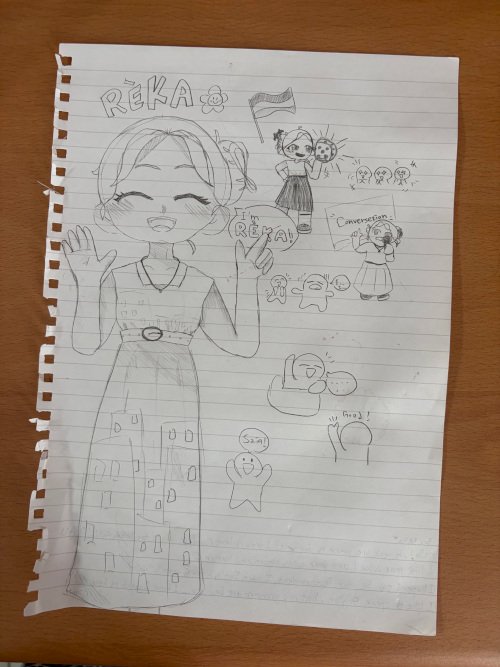
Last summer, during our summer program, one of my new students drew a picture of her very first English class.
She carefully drew my outfit. She drew the classroom rule: English Only!
She drew all of her classmates trying to speak English, complete with sparkling eyes.
And she drew me holding my giant die.
Out of everything that happened during the lesson, that was one of the things she remembered.
It made me realize something I had never really thought about before.
The die isn’t just a way to generate numbers.
It’s part of the experience.
Why a real die is different
Of course, Google can roll a d6.
A calculator can generate random numbers.
You can pull numbered cards or spin a homemade spinner.
All of those work perfectly well when you simply need a result.
But a real die does something extra.
When you hold it up, every student watches.
When you throw it, every pair of eyes follows it across the room.
For a brief moment, the entire class is focused on exactly the same thing.
Then comes that tiny pause before everyone sees the result. That shared anticipation is surprisingly powerful. A digital die can tell you a number.
A giant die creates a moment.
Students can touch it. Throw it. Pass it to a classmate. Cheer when it lands on the number they wanted.
Somehow, that little bit of controlled chaos makes an English class feel more like a game and less like another lesson. Sometimes I joke that bringing a die into the classroom is like inviting Lady Luck herself to become your teaching assistant.
My favorite emergency substitutes
That said, emergencies happen. Maybe you forgot your die. Maybe you’re teaching somewhere new. Maybe you’re setting up an RPG session and realize you left your dice at home.
That’s exactly why I made my Instagram video.
Here are my favorite substitutes.
✏️ The pencil die
The absolute classic.
Write the numbers 1–6 on the six sides of a hexagonal pencil and roll it.
My favorite pencils for this are actually the tiny IKEA pencils.
They’re free, they’re easy to write on, and they’re just the right size.
We appreciate free teaching supplies around here.
🩹 The eraser die
Probably the cutest option. But it requires the most effort to make as well. 🙈 Most rectangular erasers already have six faces, so they’re almost little dice waiting to happen.
The only downside is fairness. If the eraser isn’t close to a cube, some numbers may have a slightly higher chance of landing face up. It can easily become a weighted die… Still adorable, though.
🎴 Playing cards
Every English teacher should own a deck of playing cards anyway. Take the Ace through 6 from one suit, shuffle them, and draw one. If you have oversized classroom playing cards, even better. Everyone can see the result from anywhere in the room. It’s still not quite as satisfying as throwing a giant die—but it’s a very close second.
✂️ A paper spinner
Grab the back of an old worksheet that’s heading for the recycling bin. Draw six sections. Spin a pencil or a pen. Longer objects are easier to spin, believe me, I speak from experience.
Congratulations! You’ve just given scrap paper a second life before recycling it.
Sometimes the fastest solution is also the easiest. Search “roll d6,” and Google has one built in. And the beauty is that it has options for all sort of other classic DND dice (d4, d12, d20 etc. )as well. I think its a cool feature.
In the end…
The best teaching tools aren’t always the most expensive ones.
Sometimes they’re just the objects already sitting on your desk, waiting for a little imagination.
But, I’ll choose the giant die every single time.
Because sometimes the most important thing a teaching tool gives you isn’t a random number.
It’s a room full of students leaning forward, waiting to see what happens next.
What about you?
Have you ever improvised a die in a funny or unexpected way?
I’d love to hear your ideas—share your favorite d6 substitute in the comments!