“Guess Who?” is a classic board game that helps students practice asking questions, describing images, and thinking strategically in English. This version features a mix of classic monsters, fun pop-culture nods, and original RPGPPT characters like Lord T-Rex and the WereCorgi 🐶🦖
It can be used all year round and also works especially well as a themed activity during Halloween. The game can be printed for pair work or displayed on screen as an interactive whole-class warm-up. The possibilities are flexible and can be easily adapted to suit your students and lesson goals.
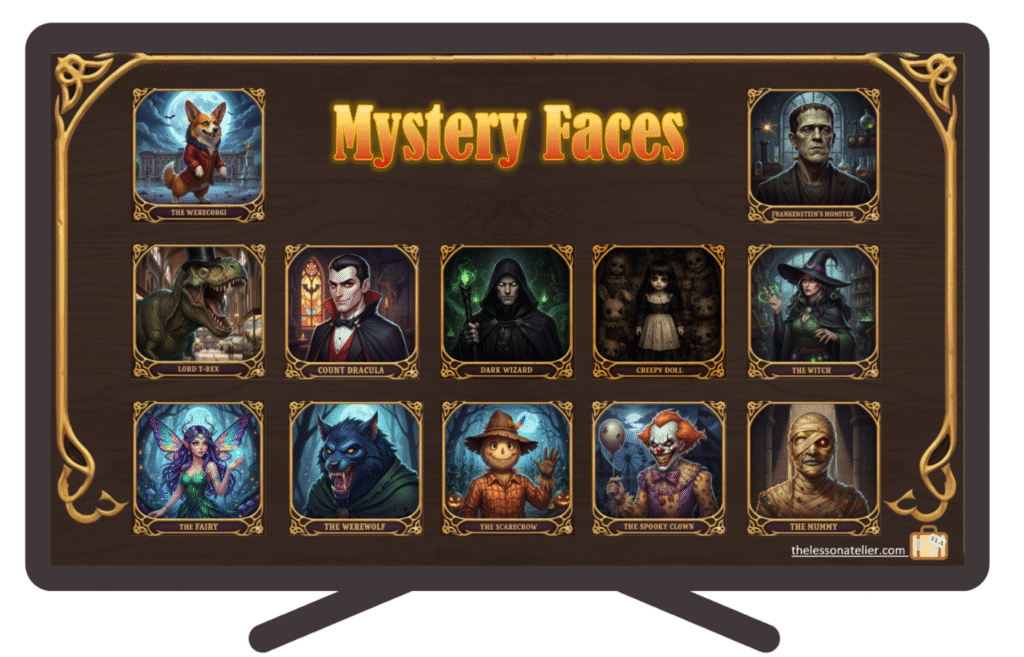
How to Play “Mystery Faces”
In the classic version, two players sit facing each other with the same set of character faces.
Each player secretly chooses one character card.
Players take turns asking yes-or-no questions, such as:
🎩 “Does your person wear a hat?”
🕺🏻 “Is your person human?”
If the answer is no, the player flips down all characters that don’t match the description.
The first player to correctly guess the opponent’s character wins!
🧩 Classroom Versions
This game can be used in several flexible ways:
🧙♀️ Printable board version:- Ideal for pair work and speaking practice
- Works best when the teacher circulates and supports English use
- 🎥 Whole-class PPT version:
- Interactive design with vanishing images
- Can be used on a projector or interactive screen
- Controlled by the teacher or by students
Preparation Instructions
Printable version
- Print the included files.
- Cut the card deck into individual cards.
- On the board, cut each image on three sides so it can be flipped up or down during the game.
- For best results, print on slightly thicker paper to improve durability and prevent see-through.
PPT version
- No preparation required — simply open the file and start playing.
- ⚠️ Please note: This version does not work in Google Slides.
Microsoft PowerPoint is required due to built-in trigger animations.
💡 Teacher Tips
This game encourages communication, logical thinking, and spontaneous English use, while keeping the atmosphere light and playful.
Pre-cut the board before class to save time.
If students are shy, begin with a whole-class demo so they can hear natural question patterns.